You Won’t Have a Career. You’ll Have a Skill Tree.
Once machines cover the work nobody chooses, a profession stops being a lane you’re stuck in and becomes a skill you can climb, collect, or play for love.
“What do you want to be when you grow up?”
Notice the shape of that question. Be. One thing.
Pick it early, and spend the next forty years becoming it.
Ask an adult what they do, and you get a job title. An accountant. A nurse. A welder.
As if the title were the person.
I think that question is about to expire.
Here’s my claim: in the world we want, you won’t have a career. You’ll have a skill tree.
If you’ve played a role-playing game, you know the picture. A skill tree is a map of everything your character can learn. You choose where to spend your time.
You can pour it all into one branch and become terrifying at one thing, or spread it around and become useful at many. Nobody hands you the build. You make it.
That’s how work should feel once survival is off the table.
Part 13: Pokémon Already Showed Us How Machine Labor Should Work used a game to show how the machines should work. This piece borrows another game idea, this time for the people.
The career was always a racetrack
Start with the word.
“Career” comes from the French carrière, “road, racecourse,” and before that from the Latin carrus, a chariot. When it entered English in the 1530s, it meant a running at full speed, a course.
As a verb, it meant to charge at a tournament. Only in 1803 did it come to mean the course of one’s professional life.
So the metaphor was there from the start. A career is a track.
One lane. One direction. You’re judged by your position against the people beside you, and the race ends at a finish line called retirement.
Step off the track for a few years, to raise a kid or try something else, and you’ve “fallen behind.” Switch tracks at 45, and people ask what went wrong.
That made sense for a long time, for reasons I’ll get to. It stops making sense the moment machines can do most of the work.
I want to replace the racetrack with a map.
The unit changes from job to skill
The concept of a career goes away. A profession becomes a skill: something you work at through a guild, or something you use in service of a quest. You can cultivate many skills, practice many skills, and apply them in different ways across many guilds and many quests.
In Part 4: Quests Should Replace Corporations, I put it like this: “you form a party when you want to take on a quest, and you join a guild when you want to learn a skill or practice a craft.”
This piece is about what that means for one person’s life.
Every skill has its own ladder
Guilds already invented the ladder. In the medieval craft guild, you started as an apprentice, became a journeyman, and, if you were good enough, a master.
The economic historian S. R. Epstein argued in a 1998 paper that this was the guilds’ main job: they existed to pass on skills through apprenticeship, and they were the main framework of Europe’s urban manufacturing for over 600 years.
Only the masters were members. Apprentices and journeymen trained under the guild’s rules without membership rights. In Adam Smith’s England, many crafts still required a seven-year apprenticeship.
Journeymen traveled from town to town; Epstein notes that in Vienna in 1742, fewer than a quarter of the city’s 4,000-plus master artisans had been born there. From the late Middle Ages, guilds increasingly used the masterpiece to test whether someone was ready to be a master.
Even the middle rank is a clue. “Journeyman” comes from journey, which goes back to the French journée, “a day’s work or travel.” A journeyman was qualified, worked for wages, and was often still on the road.
In the world we want, every guild keeps a ladder like that, open to anyone who wants to start at the bottom.
And above master, for anyone who wants it, sits a pyramid of leagues: a home tier, regional, national, and a world summit. That’s the next piece, Part 15: The Olympics, but for Everything.
Most people will live on the home tier, and it’s honored. The summit is there if you want it.
Rank is per skill, not per person
Here’s the key design choice: you don’t have a rank. Each of your skills does.
Chess already works this way. Arpad Elo designed a rating system that the US Chess Federation adopted in 1960 and the international chess federation, FIDE, adopted in 1970.
Your rating moves with every game you play. It measures your chess, not your worth.
Elo himself was a little skill tree. According to ChessBase, he was a physicist by discipline and “a fervent amateur chess player” who played at master level and won the Wisconsin championship eight times.
Now imagine a rating like that for every craft, kept by its guild.
You could be a master carpenter and a beginner cook. A journeyman nurse and an apprentice beekeeper. Nobody adds them up into one number, because there is no one number.
So your record changes too. Instead of a résumé with a job title at the top, you have two things:
- A skill map: every skill you’ve picked up, and your rank in each.
- A quest log: every party you’ve joined, what it set out to do, and whether it got there.
That tells people far more about you than “Senior Associate.”
Deep or wide, both honored
So which should you choose, depth or breadth?
Whichever you want. It just depends on your interest level.
You can go as deep as you like into one branch of the tree, and climb your guild’s ranks all the way up. Or you can collect skills like a Renaissance person, a jack of all trades. Both are real ways to live, and the system should honor both.
People have been reaching for this for a while.
The management thinker Charles Handy, whose 1989 book The Age of Unreason made his name, forecast what he called a “portfolio life.”
The Boston Globe‘s obituary of him described it as “a multifaceted, multiclient freelance career.” He saw that a working life could be a collection, not a line.
The writer David Epstein (no relation to the historian) made a related case in Range (2019): in most fields, especially complex and unpredictable ones, he argues that generalists are primed to excel, and that they often find their path late.
But the most famous version is much older.
In The German Ideology, written in 1845–46 and published in full only in 1932, Karl Marx and Friedrich Engels imagined a society where you could do one thing today and another tomorrow: “to hunt in the morning, fish in the afternoon, rear cattle in the evening”, and criticize after dinner, without ever becoming a hunter, fisherman, herdsman or critic.
That last part is the whole point. You do the thing without the thing becoming your identity.
Marx and Engels thought that freedom required communism, with society regulating production. I think it requires something they couldn’t have imagined: machine labor on demand.
Why we specialize today
To see why, ask why we specialize in the first place.
The original argument comes from Adam Smith, in The Wealth of Nations (1776). His famous example is a pin factory.
Ten workers, each doing one step, could make “upwards of forty-eight thousand pins in a day.” Working alone, Smith said, each of them might not have made twenty.
Specialization made us rich. That part is real.
But Smith saw the cost, too. Later in the same book, he warned that a person whose whole life is spent on a few simple operations generally becomes “as stupid and ignorant as it is possible for a human creature to become.”
Strong words from the patron saint of the division of labor.
So why do people stay in one lane, even when they’d rather not?
Marx and Engels answered that in the same passage. Under the division of labor, a man is a hunter or a fisherman, and has to stay one “if he does not want to lose his means of livelihood.”
That’s the lock: livelihood.
You don’t stay an accountant for 30 years because accounting is the only thing you could ever love. You stay because switching is a risk to your rent, your healthcare and your kids. The career is a racetrack because stepping off it can cost you everything.
Now take survival off the table.
That’s what the floor does. The whole series fits in one line: universal basic goods and services, powered by universal machine labor on demand, distributed by universal basic capital.
Your essentials, from food and water to housing and healthcare, stop depending on your job. So there’s no livelihood to lose.
Once that’s true, people concentrate only if they want to.
And the human-will rule handles the rest. As I wrote in Part 2: If a Human Wants to Do a Job, a Machine Shouldn’t Take It: “if a human wants to do it, a human gets to do it. Everything else is covered by machine labor on demand.”
So when you leave the bakery for a season to go build boats, the town still gets its bread.
Machines cover the gap until you, or someone else, wants the ovens back. Smith’s productivity doesn’t disappear. It just stops needing you to be the pin.
Football, and every other trade
Let me make this concrete with football, since it’s been on my mind lately. Then I’ll show why it’s not really about football.
There are at least four ways to have football in your life.
- Be a fan. Follow a club, know the table, go to matches. That’s a real relationship with a craft.
- Play in a local league. In 2023–24, England’s Football Association counted over 1.4 million registered players. Nearly all of them play grassroots football, on weekend mornings, in leagues nobody outside town has heard of.
- Make the climb your quest. Wrexham, which I’ve just started watching, became the first side to win three consecutive promotions in the top five leagues of English football. Then, last May, the fourth promotion slipped away: a 2–2 draw with Middlesbrough on the final day left them seventh, one place outside the play-offs. It was still the highest finish in the club’s history. That’s what a quest looks like. Sometimes you fall just short, regroup, and go again next season.
- Play for love of the craft. “Amateur” comes from the Latin amator, “lover.” Etymonline notes that “amateur” often carried a sneer of “dabbler,” but not in athletics, where the sneer used to fall on the professional.
Here’s the thing: since we don’t have careers in the same way, your career could very well be football. Not because you’re one of the best in the world, but because it’s what you choose to spend your seasons on.
Now don’t get distracted by the sport. Imagine every trade set up the same way.
- Cooking. Eat well and cheer for your favorite cooks. Cook for your street’s weekly dinner. Climb your guild’s ranks toward the world summit. Or bake bread on Sundays because you love the smell.
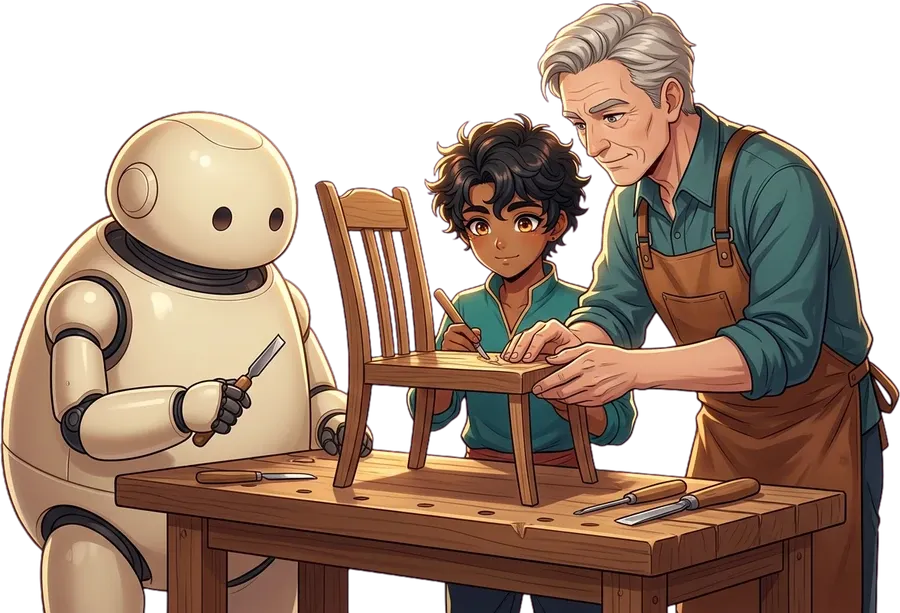
- Carpentry. Admire good furniture. Fix your neighbors’ fences. Apprentice for years and become a master. Or build one chair, slowly, because you want to have built it.
- Coding, farming, welding, teaching, nursing. Same four doors, every time: appreciate it, practice it locally, climb it, or love it.
And you don’t pick one door for life. People live in seasons.
Most of us have many interests. You might spend a spring on a farming party, a summer coaching kids’ football, and a winter on a coding quest to rebuild your town’s water dashboard.
Some years you go deep. Some years you wander.
Quests have ends, too. As I put it in Part 4: “We should instead work on specific projects until they’re finished, and then move on to work on other projects.”
The end of a quest isn’t a layoff. It’s a door.
Your goals, and the ones we share
Everything so far is about your own goals: the skills you want, for your own reasons. A society has goals too.
We want to cure diseases, advance science, rebuild the grid and take the drudgery off everyone’s plate. Some of that takes people learning hard things, and a town can’t count on someone wandering into them by chance.
So the shared goals get a list. Each community stack-ranks the learning and skill areas it needs most, in the open, and puts resources behind them: coaching, tools, materials, and early access to machine time.
That list sits in the top tier of how machine labor gets handed out, alongside the essentials and urgent shortages, as I lay out in Part 17: Keep Money, Add a Second Ledger. A town short on nurses or grid engineers can put those branches near the top, and anyone who wants to climb them gets backing to do it.
Nobody is assigned to the list. It’s an invitation with resources attached, and you can ignore it entirely and keep your floor.
The idea goes back to my first post on this blog, about what I called the noosphere: a shared layer of human knowledge that everyone adds to and draws from. That version asked people to record their learning in exchange for a home. I’d build it the other way around:
- Consent first. Adding what you learn to the shared record is opt-in, piece by piece, and never the price of anything on the floor.
- Local by default. Your learning record stays on your own machine and with your guild unless you choose to share it.
- Personal spaces are never recorded. Not your home, and not your devices.
- You own what you contribute, and you keep a share of what it earns, under the five rules I set out in Part 20: Get Paid to Train the Robot That Takes Your Job.
That’s the line between a commons and surveillance capitalism. A commons is something people choose to build together. Surveillance capitalism is something done to them.
Status, yes. Power, no.
Today, power, talent and money pile up at the top, for the few people who concentrate all their time in one place.
The economist Sherwin Rosen explained part of why in “The Economics of Superstars” (1981). As the Minneapolis Fed summarizes, Rosen noticed that top performers earn enormous incomes, far above the next rank down, even when most people can barely tell them apart.
One reason: lesser talent is a poor substitute for greater talent. In Rosen’s words, “Hearing a succession of mediocre singers does not add up to a single outstanding performance.”
The other reason is technology. Before the phonograph, your town’s best singer might be the best you’d ever hear. After it, Enrico Caruso could reach the whole globe.
Mass media turns small differences in talent into huge differences in income. And huge income turns into ownership, and ownership into power over things that have nothing to do with the original talent.
In the world we want, fame still exists. People will know who the best welder in the region is, and who scored the winner in the national final.
That’s good. Recognition is one of the best reasons to get great at something.
What changes is that fame can’t turn into ownership or power, for four reasons:
- The floor and universal basic capital are equal and can’t be sold. Everyone gets the same floor, and everyone holds the same stake in the machines that produce it. Being famous doesn’t get you a bigger share of either, and nobody can sell theirs to you.
- Nobody is paid to play. Promotion earns status, harder problems and bigger quests. It never earns a bigger floor, and machine labor goes to quests by demand, not to ranks.
- Competitive team leagues use an auto-draft. Players are stack-ranked by rating and spread across teams by a randomized draft, so every team gets an equitable share of the best. A star can’t stack a super-team and own the league. Outside the main leagues, you work and play with whoever you like.
- Time is finite. Rank is per skill, and nobody has the hours to top every tree. The best potter in the world is a beginner at almost everything else.
So here’s the rule I’d put on the guild hall door:
Status, yes. Power, no.
What the design has to handle
A skill tree sounds lovely until a bridge needs to get finished. So here’s what it has to get right.
Reliability
Some quests can drop people mid-way. Others can’t. A harvest, a hospital ward, or a school year needs people who show up.
So for quests that need commitment, you sign on for a season. The party writes the length into its charter, and you keep your word.
If something truly comes up, machines cover the gap, but your quest log shows what you finished. A reputation for finishing what you start is one of the most valuable things on the map.
Licensing for the dangerous stuff
Anyone can start learning anything. Not everyone gets to operate on your heart.
For safety-critical skills like surgery and electrical work, guilds should license strictly.
Today, the US Bureau of Labor Statistics says most electricians train through a 4- or 5-year apprenticeship, with typically 2,000 hours of paid on-the-job training a year, and most states require a test and a license.
Keep that rigor. Change the gate. The test should check your skill, not limit the headcount.
Open admission to learn, strict standards to practice on other people, and no quotas.
Honoring deep specialists
A world of wanderers would never cure a disease.
The economist Benjamin Jones calls this the burden of knowledge (2005; published 2009). As fields pile up knowledge, each generation of innovators needs more education to reach the frontier, so they narrow their expertise and lean more on teams.
His title includes a phrase that fits this piece a little too well: “the Death of the Renaissance Man.”
So the deep path isn’t a lesser choice. It’s how frontiers move. In Part 4, I pointed to Japan’s shokunin, “craftspeople who spend decades refining a single craft.”
Some people will want to give one skill fifty years. The guild’s top ranks, the hardest problems and the world summit are there for them, and so is the machine labor their quests ask for.
Matching people to quests
If everyone moves between quests every season, someone has to solve the matching problem. Luckily, someone did.
The 2012 Nobel Prize in economics went to Alvin Roth and Lloyd Shapley “for the theory of stable allocations and the practice of market design.” Shapley helped develop the Gale-Shapley algorithm, which produces a match where no two people would both rather be paired with each other.
Roth then helped redesign real systems with it, including the one that matches new doctors with hospitals.
That system works at scale. This year’s US residency match was the largest in its history: 44,344 positions offered, and 93.5 percent filled when the algorithm ran.
Quests can work the same way. Parties post the roles they need. People rank the quests they want.
The algorithm finds a stable match. And the rule from Part 4 still holds: “Since agency is the whole point, humans get the first pick of roles in a party.”
Objections
Won’t everyone become a dabbler?
Some people will dabble, and that’s fine. “Dilettante” comes from the Italian for “to delight,” and it originally meant a devoted amateur, with no insult attached. A town full of people who love a dozen things is not a problem to solve.
But plenty of people will go deep, because depth is its own reward and the ladder is right there. Look at football: over a million people in England play for fun, and the climb never runs short of people who want it.
Who does the boring work?
Machines, unless someone wants it. That’s the human-will rule.
Some people genuinely like work others find boring, and they get first pick. Everything else is covered by machine labor on demand.
Isn’t this just the gig economy?
No. It’s the opposite.
The gig economy is what Handy’s portfolio life turned into without a floor. In a 2021 Pew Research survey, 16% of Americans said they had ever earned money through an online gig platform.
Among current or recent gig workers, roughly six in ten said that money was essential (23%) or important (35%) for meeting their basic needs.
That’s a portfolio built on fear. You juggle gigs because you have to, and every one of them can vanish.
A skill tree flips each part. The floor comes first. Nobody is paid to play, so no platform sits between you and your craft taking a cut.
And your skills, ranks and quest log belong to you, not to an app.
What if I just want to do one thing my whole life?
Then do it. Nothing here forces you to wander. The point isn’t that everyone should collect skills.
The point is that nobody should be trapped in one.
Off the track
For two centuries, a career has been a racecourse. One lane, one direction, a finish line at 65, and the fear of falling behind the whole way.
That track existed because we had to earn our survival. Once machines can cover what nobody chooses to do, we don’t.
So burn the lane markers. Climb one branch to the top of the world. Or light up the whole tree.
Spend a season on the farm and a season on the pitch. Be a master at one thing and a cheerful beginner at five others.
You won’t have a career. You’ll have a skill tree.
And if you want to know what the top of each branch looks like, that’s Part 15: The Olympics, but for Everything.
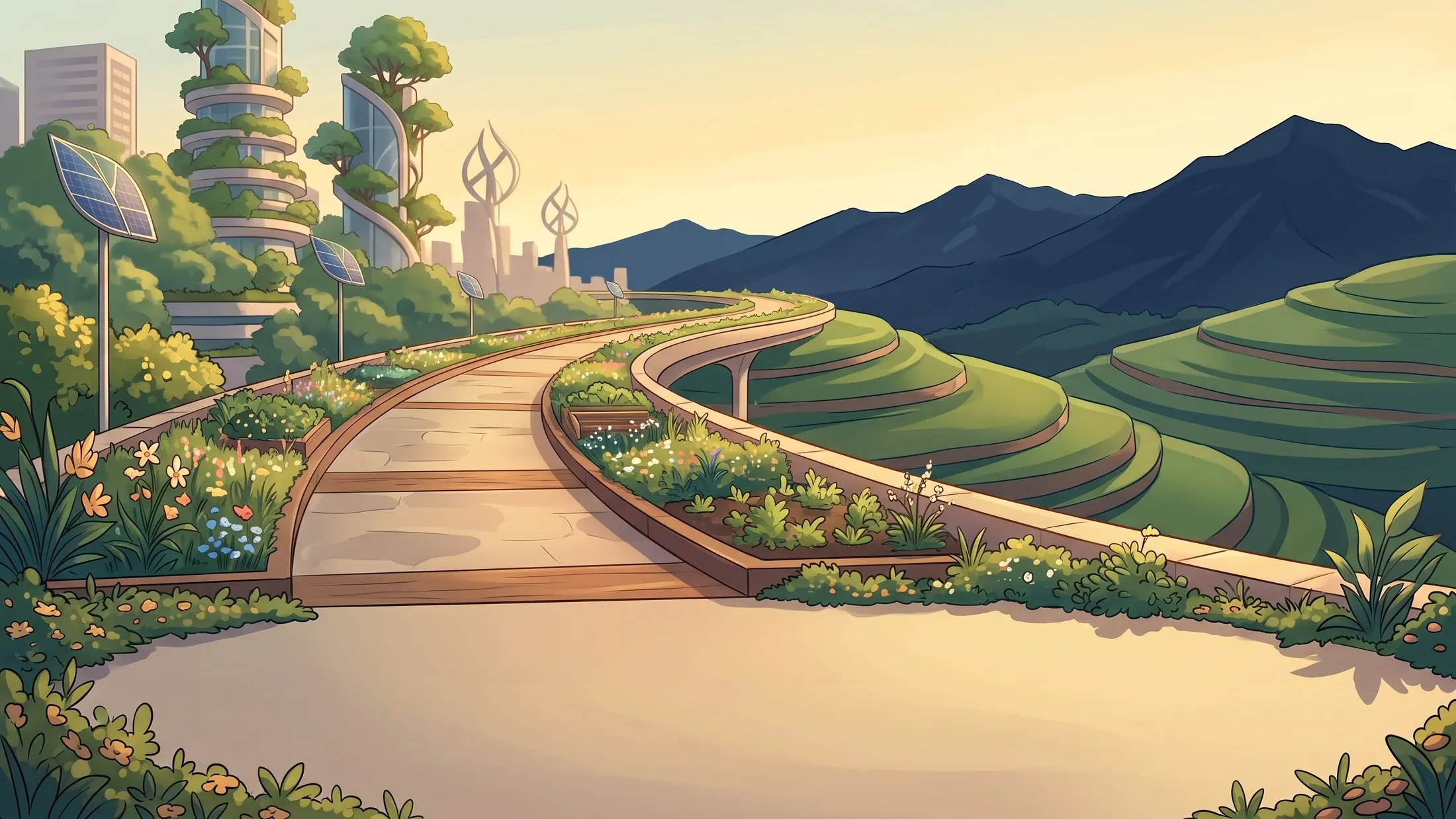
From racetrack to map
One lane for forty years, or a tree you grow

One lane, one direction. Step off, and your livelihood steps off with you.
Deep or wide
Spend your seasons. Every skill keeps its own rank.
Seasons6 left
Your skill map
Every build starts at the root.
No total score: each skill keeps its own rank
Toy model: six seasons to spend, four ranks per skill. The point is the shape, not the numbers.
Matching people to quests
People pick first. Machines fill the rest.
Toy model: made-up people and rankings. The method is the Gale-Shapley match the essay describes: people ask, quests hold their best fits, and the rest ask again.
Futurespective
The AI industry has had years to tell you what’s in it for you. They failed. Here’s my attempt...
New essays from Futurespective, in your inbox.