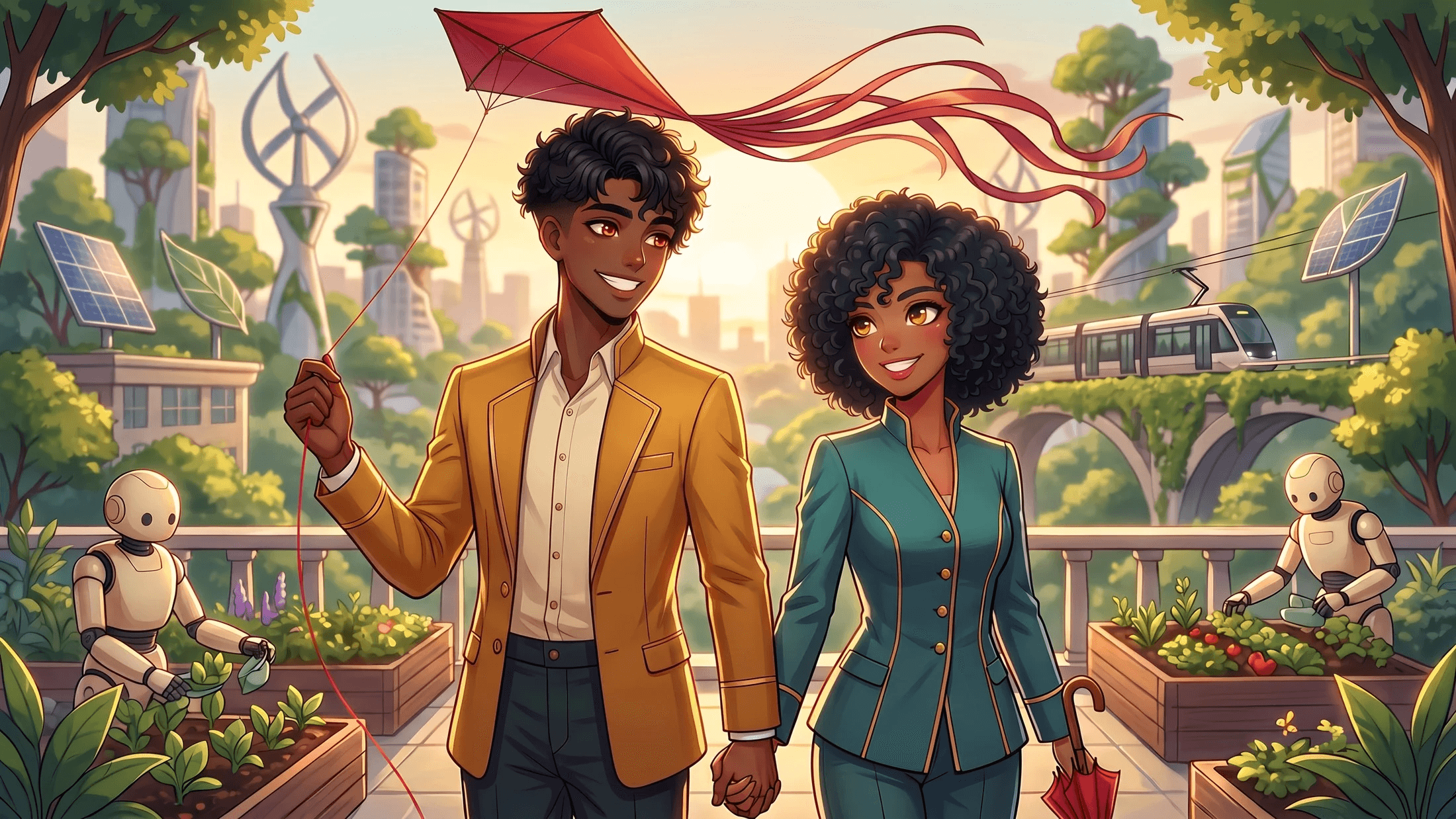
Machines Can Make Us Both Free and Safe
Part 1 of The World We Want: the case that machine labor can make us both free and safe, and a map of the series that shows how.

What world do we want to live in? I think the answer is obvious, and yet, nobody has articulated it quite the way it needs to be. So I’m going to try:
We want to live in a world where we can do anything we want.
What enables this?
Freedom and safety.
Freedom and safety are twins
We want to live in a world of maximum agency, and maximum protection from harm.
Many people (rightfully) think these things are mutually exclusive from one another. I think they are divine twins. In order to be free, we must also be safe.
Think about Earth. We are free to roam the Earth because the Earth is a safe environment for us. We have air to breathe, food to eat, an atmosphere regulating our temperature and physics to keep us grounded.
Sure, there are natural disasters now and then, but most of nature is not experiencing disaster at any given time, so in general, Earth is safe.
Sure, there are other life forms that want to kill us from time to time, including other humans, but if we work to either keep our distances from these would-be harm-doers, and/or ally ourselves with like-minded others who value safety, we can avoid them.
But most of the danger we face day to day isn’t the planet. It’s whether we can afford to live on it. That’s the kind of safety I mean here: safe from financial ruin, hunger, or losing your home.
The answer, in brief
So how do we build a future world that is both free and safe?
Imagine some future state where we have AGI-like capabilities, meaning an AI system that can do anything a human can do, and these capabilities have naturally diffused across the economy.
Looking forward from today, how do we proactively shape this future state in such a way that this future world becomes both maximally free and maximally safe?
Here’s my answer, in brief.
Freedom and safety can come from the same source: machine labor on demand.
That means intelligent machines we can call on to do any job, scaled up or down as needed, producing universal basic goods and services for everyone.
What constitutes universal basic goods and services?
Food, water, energy, housing, healthcare, transport and communication: the actual things we need to live, provided from a world of abundance powered by machine labor on demand.
Put these two things together, and you get:
- Safety from having your needs met, always, no matter what happens to your job or your luck.
- Freedom from reorienting the economy around human will, with everything else covered by machine labor on demand.
You have a world where you can do anything you want because your needs are entirely met. It is a world of ultimate self-actualization.
Many technologists and AI companies talking about a post-scarcity abundant future powered by AI have articulated something similar to the above equation.
The missing piece is a simple rule I’ve never heard any of them say: in the future we want, if a human wants to do something, a human gets to do it.
This is, by my estimation, a radical concept among AI researchers who believe AI will be able to do anything and everything better than humans.
What I’ve tried to stress in this series of essays is that humans will ALWAYS want to do things, so we must plan for this future.
Put differently: any plan for the future that DOES NOT account for this core human need (maximum agency) is not one we should pursue.
Getting to this ideal world takes three big changes. We have to…
Change #1: Create machine labor on demand.
Change #2: Point it at every critical resource and skillset that’s currently scarce.
Change #3: Replace the corporation with new ways of organizing ourselves that I call parties and guilds.
And one way to share everything those changes make: universal basic capital.
Every resident owns an equal share of the machines that make their essentials (what we mean by “universal basic goods and services”), so the gains from machine labor flow to everyone, not just to whoever builds the machines.
Notice what that adds up to. Most proposals for sharing the gains from AI pick one thing to hand out: a check, free services, or a stake in the capital. This system provides services, goods and capital, together.
Services come in the form of machine labor on demand: work you can call on whenever you need it. And it’s for everyone.
That’s the thing I’ve been advocating all along without saying it out loud: machine labor on demand for all. Call it universal basic machine labor.
Everyone starts with a personal machine, their own AI machine intelligence model (think of today’s AI) embodied and capable of doing machine labor (think robot), and anyone can request more for a quest, a guild or their community.
Goods are the byproduct of those services: the food, homes, energy, devices, and otherwise downstream products that machine labor makes.
Capital is ownership of that machine labor and its input resources, and of how its output gets distributed. That’s universal basic capital: you don’t just receive a floor of basic necessities, you own a piece of whatever makes it.
Put it all in one line, and the world we want is universal basic goods and services, powered by universal machine labor on demand, distributed by universal basic capital.
Below, I’ll walk through who has imagined a world like this before, and where I think they fell short. The rest of the series takes each change in turn, along with the objections I expect.
How this series works
This piece is the map. The rest of the series fills in the territory, one piece at a time.
The series comes in three books. Book One: The world we want (Parts 0 to 8). What we want, and the three changes it takes to get there.
Part 1: Machines Can Make Us Both Free and Safe. You’re reading it.
Part 2: If a Human Wants to Do a Job, a Machine Shouldn’t Take It. What machine labor on demand is, why it should fill gaps in the labor market instead of replacing people, and what the AI industry plans instead.
Part 3: Point the Machines at What’s Scarce. Why things are scarce, and how machine intelligence can break those scarcities through science.
Part 4: Quests Should Replace Corporations. Why the corporation won’t survive machine labor, and the two organizations I think replace it: “questing” parties, single-use companies around a single goal, and guilds.
Part 5: Every Town Can Own Its Own Power Plant and Chip Fab. Why local distributed and decentralized communities, not AI labs or the state, should own these machines, through universal basic capital.
Part 6: UBI Won’t Work. Universal Basic Goods Will. Why a check can’t do what the resources themselves can, and what money is still for.
Part 7: We’re Less Than a Decade From the Next Economic System. What every past transition between systems of power had in common, how long each took, and why the next one is less than a decade away.
Part 8: AI Will Kill Packaged Meaning. Let It. Why AI ends the industrial story of why we strive, and why curiosity and care for others should take its place.
Book Two: Living in it (Parts 9 to 16). What work, culture, status and meaning look like once the floor is built, from a planet run like a garden to skill trees, career leagues, and exploring the universal frontier.
Book Three: Building it (Parts 17 to 24). How we go from here to there, covering everything from building the second knowledge ledger and the tax formula to fund the safety net, to the law, and the first towns to try it.
If you’re coming from The AI Industry Has Never Told You What’s In It for You, welcome. This is the pitch I think technologists should be making: a path to building the world we actually want.
Who’s tried this before
So what else has been written about this?
In 1930, in the depths of the Great Depression, the economist John Maynard Keynes wrote an essay called “Economic Possibilities for Our Grandchildren.”
He predicted that within a century, technology and compounding growth would make people in advanced countries four to eight times better off, and that people might only need to work fifteen hours a week.
The economic problems of his time would be solved, and humanity’s real challenge would become figuring out what to do with its freedom.
He was half right. We got the wealth. We didn’t get the time off.
The gains went into more consumption and more work instead of more time, because our systems still tie survival to a job.
Flash forward to 2016, where the historian Rutger Bregman picked up the thread in Utopia for Realists, arguing for a universal basic income (UBI), a fifteen-hour workweek, and open borders.
His case for UBI rests on an idea I agree with: poverty is a lack of cash, not a lack of character, so give people money and let them decide what to do with it.
Where I part ways with Bregman is the check itself. If everyone gets more money but the supply of housing, healthcare, and food stays the same, prices rise to absorb it.
Cash only works if there’s more than enough of the things it buys.
Then in 2019, Aaron Bastani went further than Bregman in Fully Automated Luxury Communism. Hilarious branding, in my opinion.
He argued that automation, cheap renewable energy, asteroid mining, and synthetic food could make scarcity obsolete, and that the goal should be universal basic services: housing, healthcare, transport, education, and communication, free to everyone (don’t worry, I’ll come back to the asteroids in Part 5.)
That’s the closest I’ve seen to what I’m describing. But Bastani’s route runs largely through the state: to achieve this goal, we would have to bring key industries into public ownership.
I don’t think I need to tell you, but centralized ownership doesn’t have a fantastic track record.
Historically, it concentrates power and creates the wrong incentives.
So here’s how I’m internalizing this evolution:
- Keynes outlined the destination.
- Bregman tried to reach it with money.
- Bastani tried to reach it through the state.
I propose:
- We reach it through science, by making the things we need abundant.
- We do this by producing and distributing machines that make things locally, everywhere.
- We reorganize “work” around whatever people actually want to do.
The world we want
My point with this thought experiment is that the world we want is one of maximum freedom and maximum safety.
In order to be free, we have to be safe, and in order to be safe, we need our base needs met first and foremost.
If we focus our efforts on setting up a world of maximum freedom through the production of universal basic goods and services, we can create a world where you are free to work on whatever project or craft you find most personally valuable at any given time, working on it whenever you want, for however long you want, all because the rest of your needs are met.
You are free, because you are safe.
Safe from financial ruin, or a health crisis, or being kicked out on your butt, because you can always get what you need.
And if we produce universal basic goods and services at scale like we’ve discussed here, then there will be no need for concepts like the social safety net or retirement.
The social safety net in this world is just society itself, working how it’s supposed to; it’s safe by design. And retirement is nonexistent, or perpetual, depending on your point of view.
You could “retire” from a given project or a certain guild, but you never really retire. You do what you want, whenever you want. You’re retired all the time.
Until that floor is built, we’ll need a bridge: a cash safety net that switches on from the data. I lay it out in Plan for the Bad Transition.
This also reshapes the oldest fight in economics.
For two centuries, we’ve sorted ourselves into two camps: capital and labor, owners and workers. Each side needed the other, and each side fought the other for a bigger share.
Machine labor on demand changes what each side is.
Capital becomes safety. When every resident owns an equal share of the machines that make their essentials, a share nobody can sell, ownership becomes the floor under everyone.
Labor becomes freedom. When machines cover the necessary work, work becomes something you choose: if a human wants to do it, a human gets to do it.
Capital and labor were enemies. Safety and freedom are twins.
There’s still a fight, but it moves. It’s whether the machines end up owned by a few, or by everyone.
If we implement these three fixes, we can make it so every essential service, and every essential good, is available whenever you need it.
This provides maximum safety in the form of all of our basic needs being met, and maximum freedom in the form of you being able to work on whatever captures your curiosity, for as long as you find value in working on it.
These three changes are hard, but each is a direction we can start moving in.
Part 7 shows why history suggests those first steps will come faster than we think. Part 19 maps them out, stage by stage.
But first, the principle everything else is built on, in Part 2: If a Human Wants to Do a Job, a Machine Shouldn’t Take It.
Freedom and safety are twins
A trade-off, or twins?
- ● Food
- ● Water
- ● Energy
- ● Housing
- ● Healthcare
- ● Transport
- ● Communication
Freedom
Safety
We want to live in a world where we can do anything we want.
Switch views, then move the slider. As a trade-off, safety pushes freedom down. As twins, every need that’s met lifts both of them.
Three big changes
From machine labor to a world where you can do anything
A flow diagram. Change #1, machine labor on demand, feeds Change #2, pointing it at what’s scarce; together they fill a gold floor of universal basic goods and services (food, water, energy, housing, healthcare, transport and communication), which gives safety. Change #3, parties and guilds, reorganizes the economy around human will, which gives freedom. Together: a world where you can do anything you want.

● Safety
Universal basic goods and services
- Food
- Water
- Energy
- Housing
- Healthcare
- Transport
- Communication
Safety from having your needs met, always.
Read Part 6 →♥ Freedom
An economy around human will
If a human wants to do something, a human gets to do it.
A world where you can do anything you want because your needs are entirely met.
Who’s tried this before
Three routes to Keynes’s destination
Keynes, 1930 · “Economic Possibilities for Our Grandchildren”
Outlined the destination.
- People in advanced countries four to eight times better off within a century
- A fifteen-hour week, a century on
He was half right. We got the wealth. We didn’t get the time off.
Bregman, 2016 · Utopia for Realists
Tried to reach it with money.
- A universal basic income (UBI)
- A fifteen-hour workweek, and open borders
Cash only works if there’s more than enough of the things it buys.
Bastani, 2019 · Fully Automated Luxury Communism
Tried to reach it through the state.
- Universal basic services: housing, healthcare, transport, education, and communication
- Key industries brought into public ownership
Centralized ownership doesn’t have a fantastic track record.
This series · The World We Want
Reach it through science.
- Make the things we need abundant
- Machines that make things locally, everywhere
- Reorganize “work” around whatever people actually want to do
Futurespective
The AI industry has had years to tell you what’s in it for you. They failed. Here’s my attempt...
New essays from Futurespective, in your inbox.