Quests Should Replace Corporations
Part 4 of The World We Want: why the corporation won’t survive machine labor, and the two organizations I think replace it.
In Part 2 and Part 3, I argued that machine labor on demand can fill the gaps in the labor market, and that pointing it at what’s scarce can make the essential materials we need more abundant.
That leaves one big question: who (meaning what mechanism) organizes the work that’s left to be done?
Today, the answer is the corporation. Here’s why I think that’s about to change.
The corporation’s problem
This finally brings us to Change #3. If the “corporation” form factor is no longer serving our best interests as an effective method for pooling resources to make new things, then we should probably replace it with more effective organizing structures.
What does this mean? In the world of the future, today’s corporation-driven culture is not the appropriate organizing principle for society.
If companies can now hire intelligent machines to do work for them, they don’t necessarily need an org chart.
For starters, corporations face strong pressure, from shareholders and markets, to keep costs low and maximize returns.
This naturally means that companies must reduce headcount whenever necessary (except when pursuing “growth” at a loss, but if losing money, one requires new money coming into the organization to fund the loss. That also becomes difficult if there’s no new money).
Therefore, in an AGI-powered world, the maximum size of corporate payrolls will start to shrink over time, and will likely never go back up.
What this means is that as corporations no longer “need” to “hire” humans, they lose their value as organizing structures, because we’ll have more humans who need organizing outside of companies than within them.
Why we invented corporations
Which begs the question: why do we need corporations in the first place? Why did we invent them?
Well, we invented them to pool gigantic sums of capital together to pay for new things; often these were public works, such as canals, roads, and ships for trading goods.
These were projects no individual merchant could afford alone, but when hundreds or thousands of individuals pooled their resources together, could be managed… eventually with limited liability, no less!
Focus on that definition for a second: a corporation is lots of individuals pooling resources together to support major works. Perhaps even as equal partners.
If you’ve never been an entrepreneur or investor, this sounds like a far-off dream. In the world of today, the average person’s relationship with most companies we interact with is either as client (customer) or cog (employee).
Rarely, if ever, are we equal partners, or partners of any kind, pooling our resources into a new venture. The corporation pools its own resources, and we’re the resources.
In the world we want, perhaps the future corporation becomes truer to its original intent.
It could even evolve into something new; groups of people pooling their resources, but not necessarily to hire other people to form a company.
It could look more like pooling intelligence resources in order to tackle some novel challenge, or pooling labor resources to fill gaps in an existing market.
In a world of machine labor on demand, neither of these require hiring humans to do the work.
If there are no corporations to work for, or work with, then we don’t necessarily need jobs, or even companies.
So what if we do away with the concept of “hiring” other humans?
What if we abandon the concept of a “job” entirely?
Employees need not refer to themselves as “workers”, or identify as “labor”, a resource that can now be replaced, or ratcheted up or down as needed.
What if instead, we all identified as investors, going in on ventures together?
And what if those ventures were oriented around single-purpose objectives?
Kind of like a one-time use company?
Goals and trades
Think about why people actually want to do work once survival is off the table.
You either want to accomplish a goal, or you want to practice a trade.
Today, corporate entities sit between people and both. You need a company’s capital to chase a big goal, and a company’s payroll to make a living at your craft.
Once machine labor is on demand and owned by everyone (more on that in Part 5), that middleman mostly gets in the way.
So instead of organizing around profit, we can organize around those two motivations directly: goals and trades.
The party
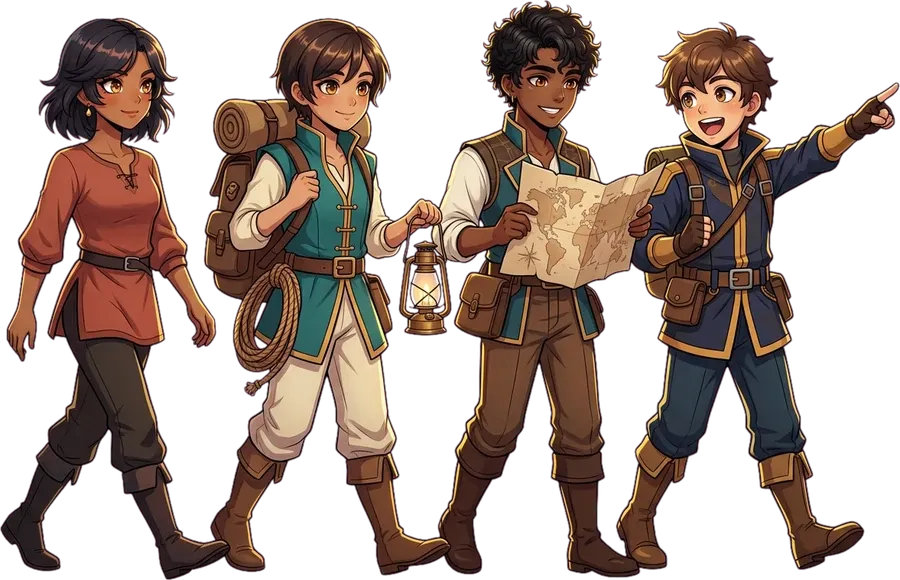
There’s actually a framework in popular culture for this: think about dungeon parties in Dungeons and Dragons.
The concept of a “party” in D&D is one where you get a ragtag group of merry adventurers together to go on some singular quest, overcome adversity in order to achieve it, and when it’s completed, all share the spoils.
Then you break off and go back to whatever you were doing before.
A quest is one goal with an end: make a film, a bridge, a new product line, or anything else. A party is just the group that forms to finish it.
Once the quest is finished, the party disbands.
Or group up again for the next one.
Now imagine that, but in real life.
In the party model, people still have roles to play. These different roles serve important, yet distinct functions inside the party. Like jobs, but less task dependent and more category dependent. You have a healer. A damage dealer. A tank. A support.
Parties are normally small; often groups of 5 in video games, or raids of 40 in massively multiplayer online role-playing games.
Anthropologist Robin Dunbar estimated that people can maintain about 150 stable relationships in their life, so I’d cap a party there: big enough for real projects, small enough that everyone knows everyone.
Do you see what I’m suggesting?
In today’s economy, instead of parties pursuing a single quest to accomplish a goal, we have corporations that drive most economic activity.
Sure, they have a “mission” as a company, but their real goal (as defined by their entity type) is to perpetuate onward into the future, forever spitting out profit to return value to shareholders.
Similar to parties, you group up and work for a corporation because a corporation needs a body to fulfill a task, or category of tasks.
And that’s typically where your responsibility begins and ends.
But unlike parties, there’s no end date. No curtain call. No time to wrap it up. The only end for a corporation is failure or a liquidity event, such as going public or getting acquired.
It’s one of many reasons why we have so many zombie corporations whose primary existence is to continue paying off debt obligations.
In the future, when machine intelligence and machine labor gets diffused throughout the economy, corporations will be able to “hire” intelligent bodies (robots & AI agents) on demand to fulfill their needs, and to whatever extent it is economic to do so, they will favor those intelligent bodies over you. Zombie corporations who hire actual zombies to work them.
In my opinion, “parties” will be the natural human immune system response to this. Why? Because people like working with other people, and we all want things to do.
There’s a reason 95% of Americans think fondly of small businesses while only 37% say the same about big business.
We respect hustle, not strangleholds.
The disposable corporation
So as machines are able to do more valuable tasks inside the economy, corporations stop making sense as an organizing principle.
If a company can hire a machine to create goods and provide services, then so can you.
And when so much work can be handled on demand, a permanent company built to service that work stops making sense.
But the big corporations of today make sense. In order to do hard things, in order to pool resources to be more efficient, you have to have scale.
Abundance is a discovery problem
However, in a post-scarcity abundant future, and the path required to get there, centralized control of resource distribution is actually incredibly inefficient.
The path to abundance won’t be planned from the top down, because the knowledge and resources it requires aren’t in any one place.
Economist Friedrich Hayek showed this decades ago: the information that matters for allocating resources is scattered, local, and always changing, so no central authority can gather it fast enough to act on it.
Prices, markets, and networks work because they let millions of people act on what only they know, without anyone needing to see the whole picture.
And Elinor Ostrom won a Nobel Prize for showing that communities often manage shared resources like fisheries, forests, and water better through overlapping local institutions than through top-down control.
So if decentralized systems coordinate this well, why do giant corporations exist at all?
Ronald Coase answered that in 1937: companies grow large only when coordinating through the open market costs more than managing everything under one roof.
That means centralization is a response to expensive coordination, not a permanent law of economics.
And technology keeps driving the cost of coordination down.
As it falls, the case for concentrated control gets weaker, and the case for distributed networks gets stronger.
Those networks are also more resilient: engineer Paul Baran’s early research on distributed communications, which helped shape the internet, showed that networks without a central hub survive damage that would cripple a centralized system.
Getting to abundance will take countless experiments, many of which will fail.
The more centralized a system is, the more it makes one big bet and fails all at once.
Contrast that to a series of distributed systems that can run thousands of bets in parallel and fail in small, survivable pieces.
Abundance is therefore a discovery problem, and no central planner can do the discovering alone.
Machines make parties cheap to form
Instead, single-use companies make much more sense.
Imagine companies built around a singular purpose that disband once that purpose is fulfilled, like parties.
There’s no incentive to grow beyond what the quest requires, and no pressure to survive once it’s done.
The catch has always been that forming a new team from scratch is expensive, which is exactly why Coase said permanent firms exist.
Every new venture has to find the right people, agree on terms, decide how to split the spoils, and build enough trust to get started.
A permanent company pays those costs once; a disposable one pays them every time.
But that kind of coordination is exactly the work machine labor on demand is good at.
The same shared machines that help a party on its quest can also help form the party: matching people to quests, drafting the charter, tracking who contributed what, and carrying each member’s reputation from one quest to the next.
And when the same people keep grouping up in the roles they’re best at, trust builds over time, the way it does in any long-running team.
With machines handling the coordination and reputations carrying the trust, the cost of forming a party falls toward zero, and the permanent corporation loses its reason to exist.
Protocols, not platforms
But whoever runs that coordination holds enormous power.
If one company owns the system that forms parties, it doesn’t just become another corporation; it becomes a landlord.
Economist Yanis Varoufakis calls this “technofeudalism”: platforms like app stores and online marketplaces don’t compete in markets so much as own them, charging rent to everyone who has to pass through.
A central party-matching platform would be the ultimate cloud fiefdom in the world we want, taking a cut of every quest on Earth.
The internet already shows a better way.
Nobody owns email; it runs on an open protocol, a shared set of rules that lets any server send a message to any other, anywhere in the world.
As tech writer Mike Masnick has argued, the early internet thrived on protocols like this, and much of what went wrong came when platforms replaced them.
Party formation should work the same way: an open protocol that lets anyone post a quest and send out a call for aid.
That call could go first to your local network, then your region, then to guilds and talent networks around the world, until the right people answer.
No central hub decides who gets to form a party, and no one collects rent on the quest.
And like Baran’s distributed networks, there’s no single point that can fail, or be captured.
Hollywood already works this way
If single-use corporations still sound scary to you, take heart in this:
There’s already a model for this, in the film industry.
Each film that gets made has a single-purpose LLC built for it to manage the work; workers come together to make the film, and when it’s done, the party is disbanded.
A disposable corporation.
Only reputations and the will to work together again carry from one project to the next.
That said, the film industry’s model is imperfect. Crews are mostly made up of paid employees, and the LLC is usually owned by a parent studio or production company that persists after the film’s completion.
What I’m proposing changes the ownership and profit-sharing, to whatever extent there is profit: the people doing the work are partners in the quest, not hired hands. They’re all investors, going in on the same venture.
Since labor can be deployed on demand, you’re picking your party based on who you want to set forth on this quest with, and what unique qualities they bring to the team.
Not who you need; who you want. Who you like.
Why must we toil and tie ourselves into knots working endlessly at a single corporation, or many corporations, until we reach some arbitrary age range of 65, or 67, or whatever it becomes as inflation increases and the social safety net becomes increasingly burdensome to support?
We should instead work on specific projects until they’re finished, and then move on to work on other projects.
This project could be an infrastructure build. It could be a new product line. The point is, it’s a single-use entity that exists not just to serve profit, but serve a function.
Of course, party members may want to group up again for new projects and challenges. And a mission completed successfully may create demand for more where that came from.
In these cases, you form a new party, or change the terms of the quest.
The guild
Now, sometimes, you won’t want to group up for a shared mission. Sometimes you group up over a shared interest, or a shared trade. Like how guilds used to work.
Don’t think about guilds as we know them today, like unions. Think of the original version.
Why did we originally invent guilds? They were started during the High Middle Ages, and were inspired by an older, Roman concept called collegia. Collegia brought people together based on shared trade, social status, or religion. Like social clubs.
Guilds, by contrast, were formed so merchants could pool their resources to protect against bandits and robbers, excess taxes, or competitors who undercut on price.
As you can see, the concept of a guild was originally created to coordinate by craft and protect from thieves, be they on the road or in the state house.
The fact that guilds in the world of today tend to protect laborers from corporations implies that something is broken in the modern interpretation.
For example, modern guilds have drifted from preserving and proliferating a trade to basic bargaining.
But medieval guilds aren’t a perfect model either; they were more like cartels that restricted entry to newcomers and fixed prices.
In the future, if price and competition are not an issue, then guilds could return to their roots and grow beyond them, transforming into a blend of industry and academia, with unique schools of thought represented as different brands and quality of the craft sought above all else.
The traditional trades of Japan offer a model for what this could look like. Think of Japan’s shokunin, craftspeople who spend decades refining a single craft, from swordsmithing to lacquerware.
Japan even designates its most accomplished masters as Living National Treasures and funds them to pass their skills on to apprentices.
That’s a guild with a public mission: keep the craft alive, raise its quality, and train whoever comes next.
So in the spirit of the shokunin and the guilds and collegia of old, interpreted anew for the world we want, perhaps you group together over shared interest, and shared skillset, to pool your shared resources towards broadening and expanding your craft.
This could be through teaching others in your trade, comparing notes and improving your skills, or simply curating a community of like-minded folk to work with.
Now, consider the guild structure, where we group ourselves together by similar interests and crafts we find valuable to develop and carry on.
The guild enables us to develop and curate hyper-specialization that can be both…
- Conducted by experts when they want to do the work in a party, and…
- Used to train hyper-specialized systems that can fulfill the role of those experts when there’s either…
- Not enough of that tradesperson in a given community, or…
- When they simply don’t want to do it that day.
- These guilds could also be organized more like collegia, around shared interests as much as shared trades, close to the “houses” I sketched in an earlier post.
Parties, guilds, and their charters
I think of the difference like this: you form a party when you want to take on a quest, and you join a guild when you want to learn a skill or practice a craft.
That also splits up the work of keeping a town running: guilds run the standing services, and parties take on the time-bound ones, anything with a finish line.
You can recruit party members from guilds, and vice versa.
Where corporations face constant pressure to produce profit for their shareholders, a party would have what’s called a charter obligation to complete the quest it’s on.
A guild could similarly have a charter obligation to pursue mastery of its craft and keep its doors open to anyone who wants to apprentice.
Humans get first pick
Since agency is the whole point, humans get the first pick of roles in a party. If you want a role, it’s yours. If no one does, a machine fills it.
And when more people want a role than a party needs, the party chooses the way it chooses everyone else: who you want to go on the quest with.
If you don’t want to work with other humans in your party, for example if you think they all stink at their role, then you could work with a party full of machines.
I find this outcome unlikely in every scenario, but it’s possible.
Similarly, if a human wants to join a guild, regardless of their current skill level, they should be able to.
Guilds would focus on documenting and preserving the form and function of their craft for teaching other humans, and also for teaching machines.
This is for times when human guild members don’t want to teach other humans how to do a trade, like say a new guild member arrives who wants to learn a trade, but is totally hopeless at it.
In those cases, the guild can have the machine guild members teach the hopeless human, with all their infinite patience and infinite time.
What else do we need?
If we do both of these things, then what organizational structures do we really need beyond parties and guilds?
We already have family units, those aren’t going anywhere.
We have governments, which again aren’t going anywhere.
However, the government’s job would change. Instead of running the infrastructure, the government guarantees the floor: making sure every community gets built out, that no one is left without universal basic goods and services, and that disputes between communities get settled fairly.
That’s a smaller job than some central coordinating body, and a more accountable one.
Which leaves us local townships, communities, clubs, and cults… all of which more or less fall into the collegia category, and are more about personal fulfillment and socialization than party or guild work would be. I wrote my initial thoughts on all that here.
Aren’t guilds just cartels?
Medieval guilds also existed to restrict entry from newcomers and fix prices.
I think about this in the context of the Writers Guild of America today. In order to join, you already have to have been paid to write for a studio that has signed on with the guild.
This is a complete joke, and a great way to enforce high wages for an elite few at the expense of the many hundreds of thousands more who study the craft and want a chance to do it.
Shouldn’t it work the other way around?
Why do we let someone go to school, get a degree in a subject, and then be withheld from practicing the craft they spent all the time learning, either by industry or by a trade union?
Make no mistake, this system works great for the people inside it, in a world where wages matter.
But for the people outside it, it forces them into the category of work they don’t want to do.
Which again, is not the world we want.
So if we play out the current trajectory into a world where wages won’t matter, then we need a more optimal system to coordinate people who want to study, learn, and practice a craft. The new guilds of the future could offer that coordination.
Parties and guilds answer how we organize work in a world of machine labor. But they don’t answer who owns the machines doing that work, and whoever owns them decides who benefits.
That’s Part 5: Every Town Can Own Its Own Power Plant and Chip Fab.

The disposable corporation
A party ends. A corporation doesn’t.
Each quest has a party, an end and a share of the spoils. Then people break off, or group up again for the next one. The corporation just keeps going.

Baran’s three networks
Knock out nodes and see which network keeps talking
Centralized one hub
100% still linked
Decentralized several hubs
100% still linked
Distributed a mesh
100% still linked
All 30 nodes running in each network.
Layouts after Paul Baran’s 1964 RAND memo (RM-3420), 30 nodes each. “Still linked” is the share of running nodes that can reach the biggest connected group. Attacks always hit the node with the most links left.
Coase’s math, redrawn
Hand the coordination to machines and the break-even point runs off the chart
Single-use parties are cheaper for the first 8 quests; from quest 9, the permanent company is.
Made-up numbers to show the shape. The company pays 40 to set up and 2.5 a quest to run. Each new party pays 7 to form when people do the coordinating, falling to 1 when machines do.
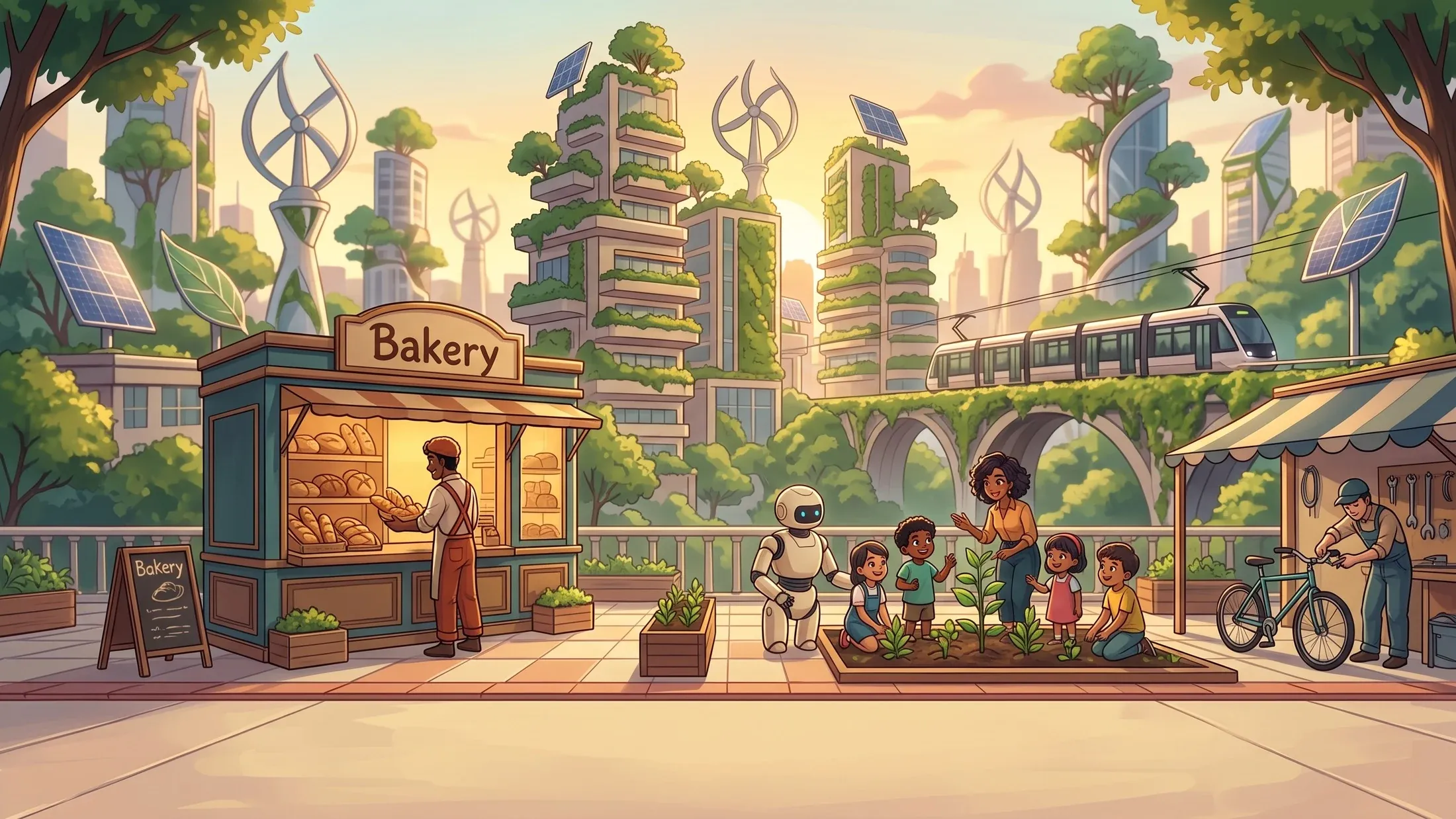
A call for aid
On a protocol, answers come straight back. A platform takes a coin from each.
Calling: your town · 0 of 4 answered · Nothing skimmed
Each ring is one step further out. The call stops spreading once the party is full.
Parties and guilds
Form a party for a quest. Join a guild for a craft.
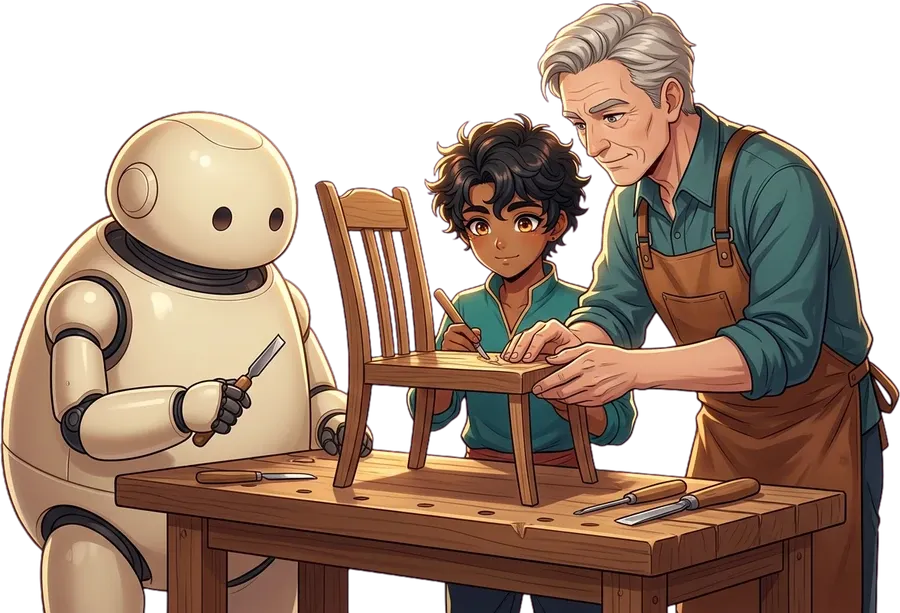
Guilds last; parties don’t. People are recruited from their guilds for a quest and return when it’s done. Inside a guild, machine members teach any newcomer, with infinite patience.
Humans get first pick
Pick your role. Machines take the rest.
3 roles for people, 1 for a machine. The quest goes ahead either way.
Tap a role to claim it or leave it.
Futurespective
The AI industry has had years to tell you what’s in it for you. They failed. Here’s my attempt...
New essays from Futurespective, in your inbox.