Every Town Can Own Its Own Power Plant and Chip Fab
Part 5 of The World We Want: who should own the machines once things are abundant, and why the answer is every community, not a company or a central planner.
In Part 3, I argued we should point machine intelligence at what’s scarce, until the scarce things become abundant. In Part 4, I argued that parties and guilds should organize the work of building it.
But whoever owns the machines decides who benefits from them.
This piece is about making sure everyone shares in the result.
Who owns the machines?
So, if people lose wages, they need some other claim on what machines produce.
On Anarres, the moneyless moon of The Dispossessed, nobody owns anything: there are farms, factories, and distribution centers that produce essential goods, and they belong to no one and everyone.
People simply use what they need.
Anarres still routes its big decisions through a coordinating body, and Le Guin shows how much power that body quietly accumulates.
I’d borrow that idea, but without any kind of central planner (per my earlier point in Part 4).
Why not the government?
You might ask: why not just let the government own it all?
Because we’ve seen how that goes.
Centralized state ownership, the way communist economies tried it, tends to reward loyalty over results and leaves no one with a real stake in keeping things running.
So the design question is really about incentives: reward the behavior we want, like building, maintaining, and sharing surplus, and make the behavior we don’t want, like hoarding, capture, and neglect, costly.
Community ownership helps on its own, because the people who depend on the infrastructure are the ones who own it.
Universal basic capital
So here’s how I’d structure that ownership. It’s called universal basic capital, and when Google DeepMind’s economists rated eleven policies for an AI economy, it scored highest of all on agency and on ownership of the gains.
Every resident holds one equal share of the machines that make their essentials. It can’t be sold, so it can’t pile up in a few hands the way shares do today.
The machines that make the essentials are held by a town trust, a legal body that owns the town’s infrastructure on behalf of everyone who lives there. Your membership in it is your share.
Half of your share sits in your own town’s trust, which gives you a stake and a vote in how its machines are run.
The other half sits in a pooled regional fund, held by the federation of town trusts in your region, so one flood or failed fab can’t wipe out a town’s whole stake.
That vote is vital. Capture usually happens one of two ways: someone buys control, or control concentrates in a few hands. A share nobody can sell, with one vote each, closes both doors.
Now, your share can’t be sold, but it moves with you. Moving to a new town works like switching your voter registration, or porting your phone number: you register there, and your share comes along.
Your town half transfers from the old town’s trust to the new one. The trusts settle it with each other, the way banks clear payments between themselves, so no one ever buys or sells a share.
Your regional half stays put if you move within the region, and transfers through the federation if you leave it. Most arrivals and departures between two towns net out in the background, in a kind of trust swap.
Your membership in both halves starts on day one, and day one counts the same as year twenty.
Towns that are growing get first priority for new build-outs of universal goods and services, so newcomers in a community never thin out anyone’s essential services (like how a share’s value gets diluted when issuing new stock).
Your share isn’t just your house and your right to food, water, and energy, though.
Housing comes through the essential goods and services you’re guaranteed, built on community land trusts, which hold land for a community permanently so it can’t be flipped.
Land that’s scarce by nature, like beachfront, will likely maintain a high price in whatever private secondary market would exist for such things.
What your share pays you first is “the floor” itself: the essentials those machines make, free to everyone.
Above the floor, the machines can still earn money, from extra use and from surplus traded with other towns.
That money pays to maintain the machines first and foremost, then to expand them, and only then goes back out to every shareholder, which is everyone.
At first, this trade will run on money, the same dollars we use today. Over time, I think it can run on the resources themselves, traded in some kind of decentralized node network tracking digitized versions of all our resources.
Once every resource on the planet is digitized, it gets easy to trade equivalent values directly, without always needing an abstraction like money to stand in for them.
That starts with ordinary databases each town runs, and maintains with the help of machine intelligence, and then moves on-chain, to shared digital ledgers nobody controls alone, where trust between towns, parties, and guilds coordinating with each other need it.
That might not always be better, so money, or some other way of keeping score of value, stays on the table as an option.
That’s how the gains from machine labor get shared: not as a check from a company or the government, but as ownership in the systems that produce the things we need to survive and power the goals we want to pursue.
Who runs the machines?
Owning the machines and running them are two different jobs. Who runs them depends on the job.
Ownership follows the nature of the thing.
Your town’s trust holds what’s tied to the place: the power, the water, the local machines that make the essentials, and the land trusts for housing. Under its charter, it stays answerable for one thing above all: delivering “the floor” (essential services) to everyone who lives there.
Guilds own their craft’s tools, from workshops to a fleet of their own if their charter needs one. Parties own what their quest builds. And you own your personal machine, and any tools built for your work.
Whoever holds a machine, the rule is the same: you hold what you use. When a machine sits idle, it’s free for anyone to call.
The trust is a utility co-op, not a government. It can’t police, tax or zone, and it has to serve every member equally, the way a power line has to carry anyone’s electricity.
Guilds run the standing services, the work that never ends, like care, repair and teaching. Parties run projects, anything with a finish line. And you run your own tasks, on your own personal machine, doing the work you want.
Anything bigger than a town could run through a regional federation of town trusts: this could be governing bodies that manage regional chip fabs, the backbone of the grid, the shared reserves of machine labor and other resources, and the coordination and distribution market between towns.
Everyone will have the same right to call on the supply of universal machine labor on demand, and requests will be filled by demand, with the essential services always filled first.
I lay out how that could work in Keep Money, Add a Second Ledger.
Microgrids for everything
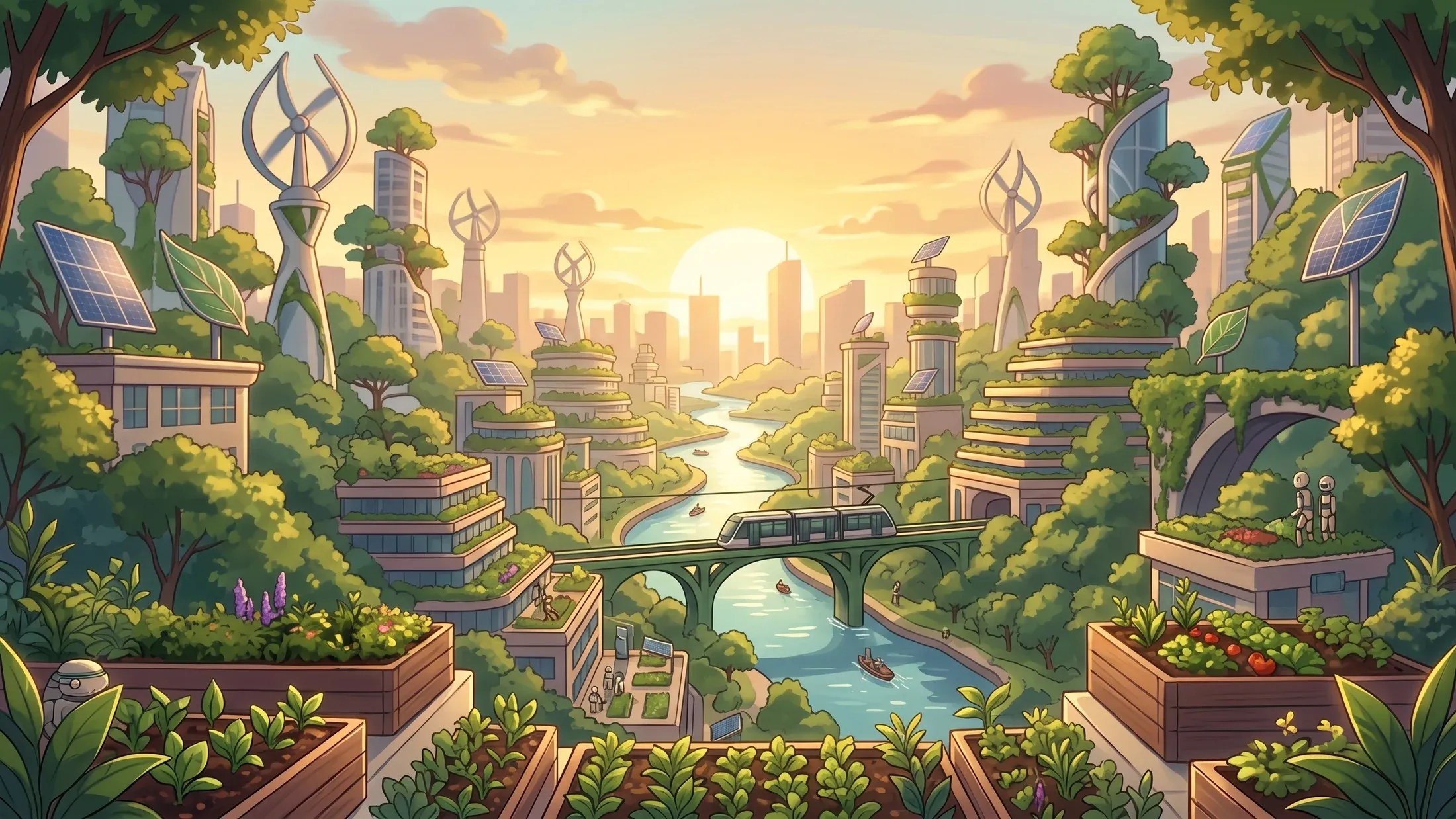
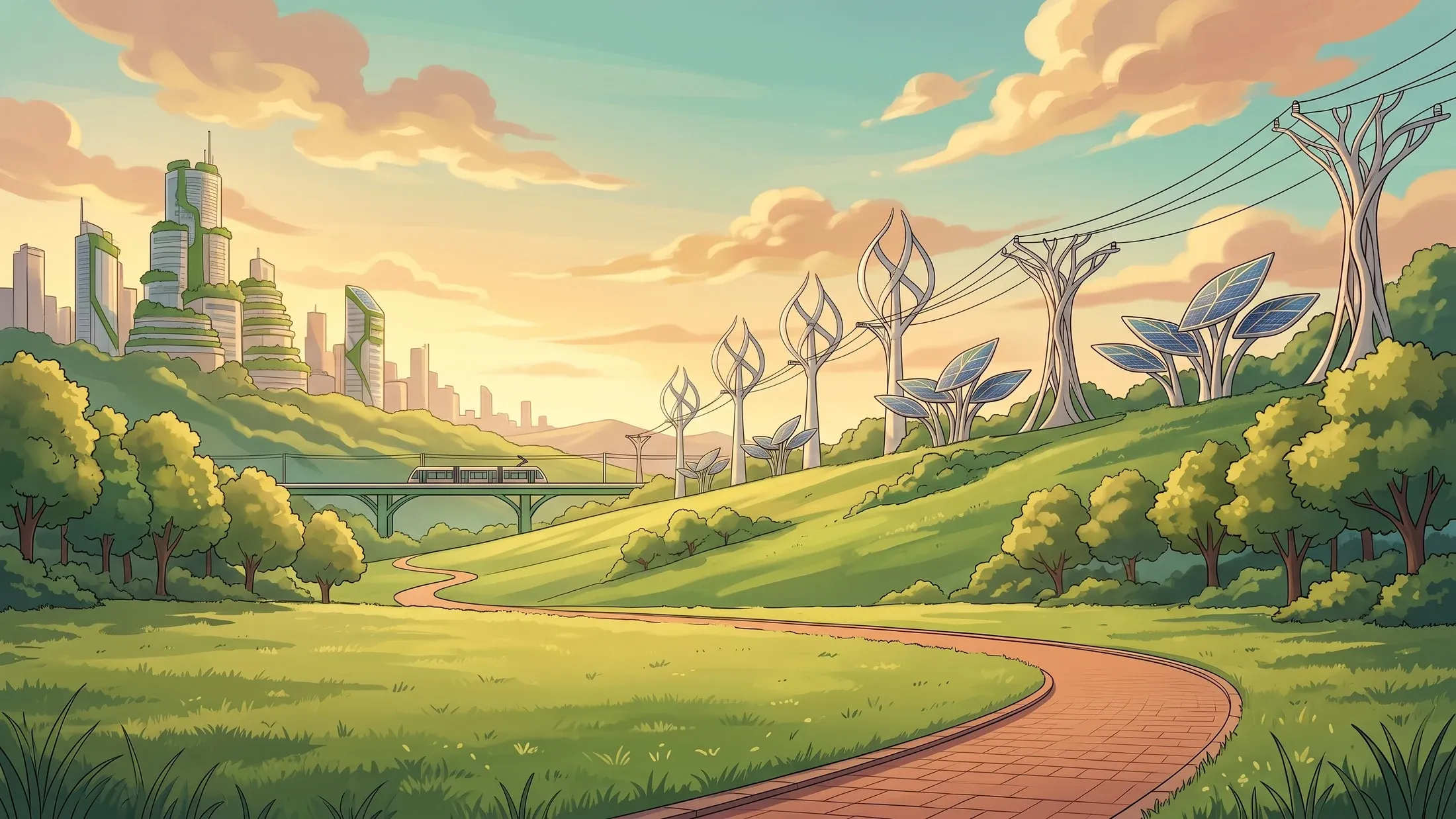
So how do we coordinate and distribute all these resources? Picture infrastructure that works like a microgrid, but for everything.
A microgrid is a local power network that can run on its own. It generates and stores energy for a neighborhood, a campus or a town, and usually runs connected to the wider grid. When the grid goes down, it can cut loose and keep the lights on.
Now apply that to food, water, building materials, manufacturing, healthcare, energy, and compute.
Each community runs its own nodes: local machines, local energy, and local computation, producing enough to cover its own basic needs at a surplus.
That’s where this ends up. It starts with resilience: every town makes its own energy and water and keeps buffers of food and medicine, enough to run its essentials through a crisis, and trades for the rest.
The nodes are networked: linked by power lines, roads, pipes and data, so each one can see what the others have and need, and send things where they’re short.
As you’d expect from the world today, communities won’t start out equal. Some sit on farmland and some in the desert. Some have rivers, and some have sun.
So when one community has a surplus and another has a shortfall, resources flow on request. No central source needs to decide who gets what.
The network runs on information. Each node posts what it has to spare and what it’s short on, and a shortage shows up as a higher price, which pulls surplus toward it, the way the wholesale market behind the power grid works.
Specialist AI systems can watch those signals, forecast demand, and route deliveries, so no central planner has to. I work through how that market runs, and how it sits beside money, in Keep Money, Add a Second Ledger.
Not everything is local yet
Now, not everything can be local at first. Chip fabs, power plants, industrial-scale farms and mines are all huge, centralized operations today.
But as machines drive down the cost of making things, while advancing technology, more and more production can shrink to fit the size of any given town.
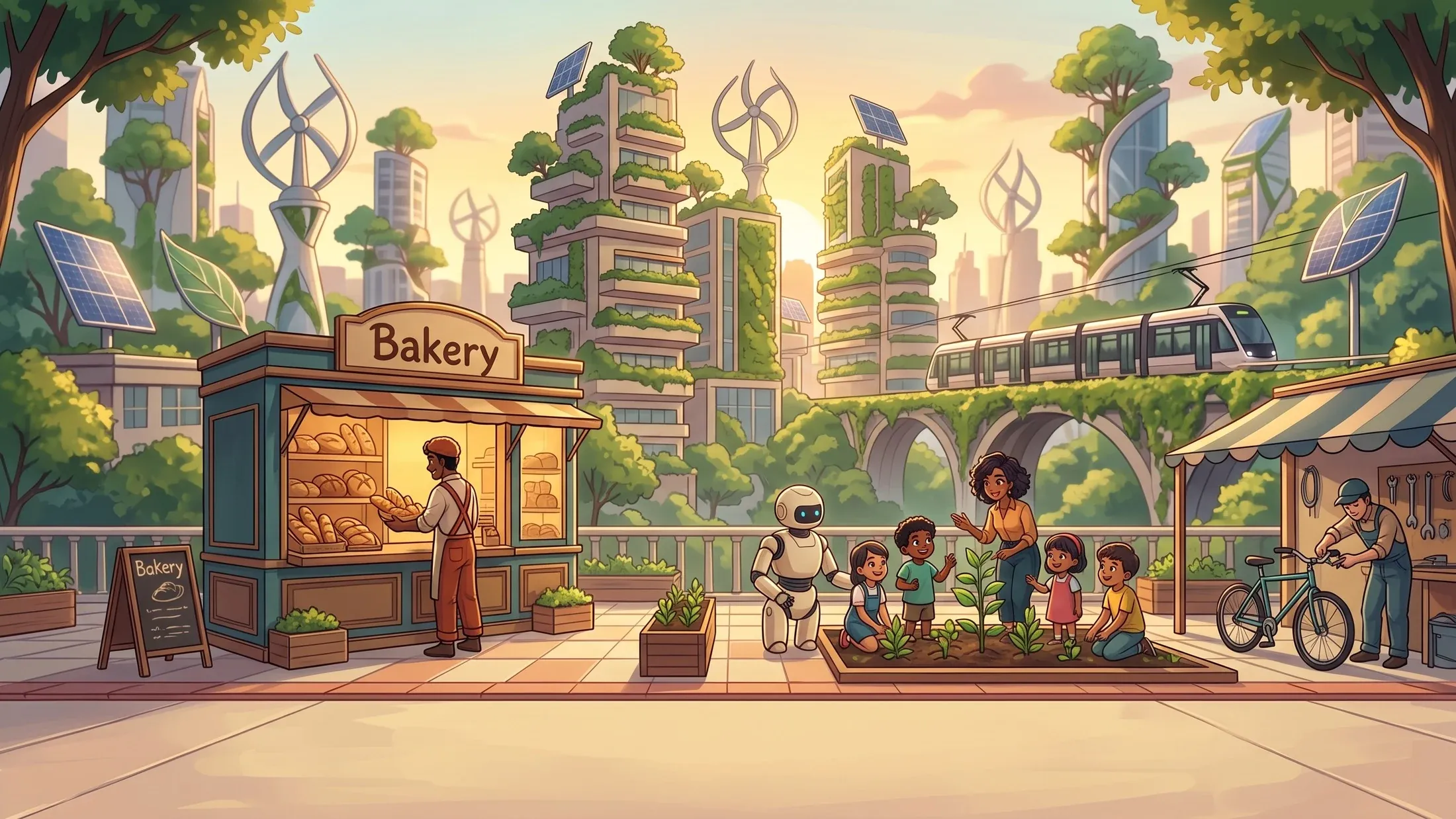
Imagine microfactories, microfarms, 3D printing for every kind of good, small-scale sustainable power and backup storage.
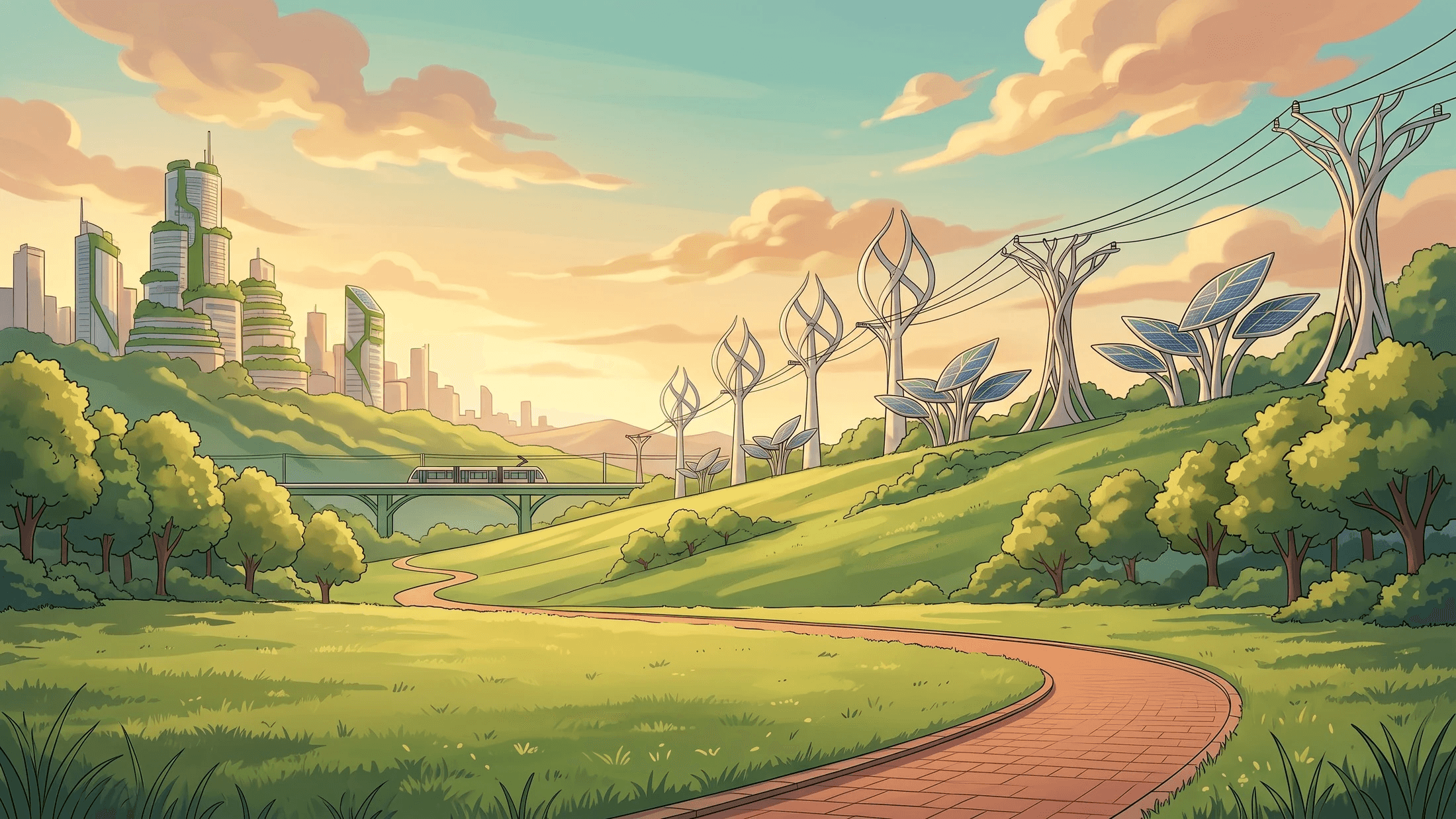
Eventually, I believe every town could have its own power plant, and a share in a regional fab.
That’s the realistic goal: self-sufficiency by region, not by town. Not every small town needs every resource, but every region, a group of towns, does, and these borders can ebb and flow with demand.
Everything is decentralized and scaled to the region it serves. A bigger plant, like a regional fab, covers the towns it represents, and is built with surplus to spare, so a swing in demand from other nodes in the region doesn’t create new scarcity.
That rule includes the end of a product’s life. Everything that gets made in an abundant world needs to be recycled, so when demand shifts and people let go of things, the materials flow back into the system.
I call this goal make absolutely everything recyclable, and it should be included in the pursuit of pointing machine labor on demand at everything scarce.
Mining is the exception to all of this, since materials are where they are.
That’s where civilization’s ultimate growth has to come from: scaling mining, eventually beyond Earth, to feed every region’s fabs and every town’s material printers and power plants.
This is one place I fully agree with Aaron Bastani. Asteroid mining is the long-term supply chain we need, and it’s where our biggest ambitions come in, like reaching other planets and someday terraforming them.
The gift-back
Building all of this will take enormous investment, and that’s where today’s capital, companies, and builders still have a role to play.
But the build-out needs an end state. Once a community’s infrastructure is up and running, truly up and running, I propose it gets gifted back to the people who live there.
Not to a town council or a company, but to the town’s trust, held for every resident in equal shares.
From then on, each community’s first job is to stay resilient, with machines maintaining the nodes and upgrading them as bottlenecks change.
And if a community wants to grow beyond its natural borders, it must grow resiliently too.
A flexible floor
What you end up with could be a kind of hybrid.
The baseline I imagine is Anarres: walk into any store, take what you need, and walk out. In practice, that’s a free first block for every household, with a price only on use above it.
On top of that baseline sit markets and capital, for building new things and trading whatever stays scarce, all running on decentralized grids that sustain themselves.
For the full design of how that trade works, read my whitepaper, The Information Economy.
The setup here would be flexible by design. The floor would be the same everywhere, but what sits on top of it is up to each community.
Above the floor, there’s surplus: more of the resources I listed in Part 2 than the essentials need, from materials and energy to built things and machine labor. A community can pool it and point it at whatever it values.
A town that cares about art can point its surplus there. A town that wants to build rockets can do that instead. Each with the same foundation, supporting different needs and different wants.
Ownership, in the end, wouldn’t be concentrated in the few companies that build the machines, or in one national fund.
The best outcome would be that it’s just held locally, by everyone, everywhere.
Objections
Of course, a vision like this raises some fair objections.
Why would anyone who builds this infrastructure give it away?
There are many reasons. They could agree to it up front, as a condition of public financing, or everyone could agree this is the world we want, and decide to do it.
For example, some might do it for legacy. When all of this gets up and running, like truly up and running, this infrastructure could be gifted back to the people.
Instead of today’s billionaires gifting their wealth in shares and cash payments after they die, they could gift the infrastructure. In the long run, it’ll do us a lot more good.
Others will be pushed by policy, the same way utilities are regulated today. And as parties take on net new build-outs as quests, more often the builders will be the community itself.
Would incumbents allow this?
Probably not without pressure.
Corporations that profit from scarcity have little reason to give it up, so this likely arrives through policy, competition from more efficient parties and guilds, and net new key infrastructure purpose-built with community ownership from the jump.
Abundance, owned locally, answers what we make and who owns it. But if nobody needs a job to survive, what do parties and guilds pool, and what happens to money?
Who owns the machines?
Whoever owns them decides who benefits
Benefits flow to everyone who depends on it
Community ownership helps on its own, because the people who depend on the infrastructure are the ones who own it.
Microgrids for everything
Every town makes its own floor, with some to spare
Tap a town that’s short to request surplus from its neighbors.
No hub in the middle: each town is a node, and surplus moves only between neighbors, only when one asks. The same goes for building materials, manufacturing and healthcare.
The gift-back
Build it, run it, give it back
Building all of this will take enormous investment, and that’s where today’s capital, companies, and builders still have a role to play.
Futurespective
The AI industry has had years to tell you what’s in it for you. They failed. Here’s my attempt...
New essays from Futurespective, in your inbox.